
The Real-Time Edge Intelligence Solutions Handbook
A Practical Framework for Building Commercial Edge Systems based on Physics and Mathematics
The Real-Time Edge Intelligence Solutions Handbook defines a new design workflow for intelligent edge systems, extending today’s Edge AI capabilities into a more disciplined and reliable engineering approach. At its core is Real-Time Edge Intelligence (RTEI) – a framework that unifies deterministic DSP, intelligent data-conditioning, and modern AI workflows into a single, coherent methodology that moves beyond traditional design paradigms. RTEI emphasizes predictable behaviour, interpretability, and standards-aligned design, reflecting the needs of compliance-driven sectors shaped by ISO and IEC requirements.
A typical RTEI system architecture demonstrating edge DSP algorithms and ML inferencing on an RTOS, with optional cloud services such as data lakes and device management. 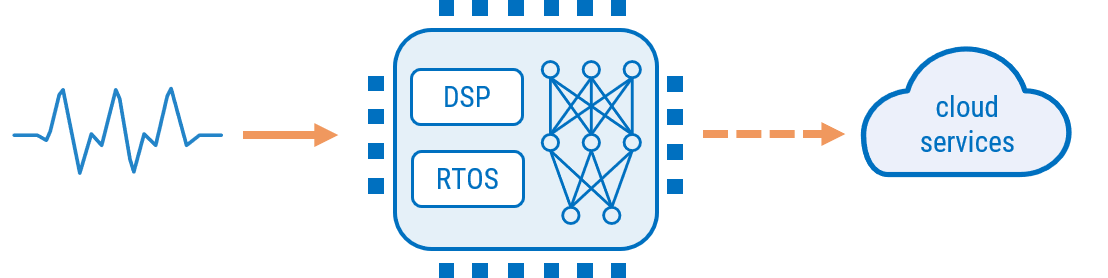
Using this system architecture as a foundation, this handbook draws on the expertise of industry experts with a strong track record of delivering commercial-grade edge systems, and provides software and system architects, product designers and researchers with a state-of-the-art overview of design methods, toolchains and workflows for building robust, explainable, and verifiable Real-Time Edge Intelligence solutions on Arm-based processors.

4.8 out of 5.0 stars
A Three-Part Journey
From foundational concepts, through signals and systems, to real-world commercial deployment.
Covering four core areas essential to building Real-Time Edge Intelligence systems.
Signals & Systems
Overview of state-of-the-art signals and systems methods and DSP algorithms for sampled sensor data in RTEI systems, including: transform-based analysis (Fourier and related variants), system modelling (Laplace/z-transforms), digital filter design (FIR/IIR), and linear/nonlinear Kalman state estimation methods.
Presented in the context of working with real measurement data, with attention to numerical behaviour and efficient implementation on embedded processors.
Data-Driven & AI Methods
Overview of data-driven methods within RTEI signal chains – use of extracted features for detection, classification and estimation, and the role of ML models alongside deterministic DSP algorithms.
Addresses the strengths and limitations of data-driven approaches, highlighting the balance between model-based engineering (human intelligence) and data-driven inference in practical RTEI systems.
Embedded Implementation & Hardware
Overview of taking algorithms from simulation in Python/MATLAB to embedded firmware – floating- and fixed-point realisation, quantisation, sampling and timing constraints, memory usage, and hardware considerations for designing mixed-signal sensor frontends.
Focus on practical implementation challenges and best practices for implementation on Arm Cortex processors.
Building Customer-Centric RTEI Systems
Overview of the New Product Development (NPD) process for RTEI systems – from requirements and specifications through to implementation, measurement and verification.
Presented with practices aligned to IEC/ISO standards, demonstrated through three detailed real-world use case examples that take systems from concept to validated deployment.
What readers are saying
Most DSP books ignore AI, and most AI books ignore physics — Dr. Sanjeev brings these two worlds together very productively, providing a signal processing text for our modern era. He hits the right depth and breadth of signal processing background, and covers everything from Fourier transforms and Kalman filters to IEC-compliant ECG signal chains deployed on Arm Cortex-M hardware.
I was honoured to serve as a technical reviewer. I highly recommend this book for anyone building products that turn sensor data into real-time decisions.
A really interesting book, I liked the history and context provided at the start. The explanation of why filtering techniques are key to developing detection algorithms was especially relevant to my work, and I found the deep dive into each filter type very useful. It will be a very useful reference book I shall come back to many times.
Purchase a Copy and Start your Journey
| Edition | Format | Price |
|---|---|---|
| Digital Edition | PDF e-book | €47.50 |
| Printed Edition | Softcover | €69 |
| Bundle | PDF + Printed Edition | €99 |
All listed prices are exclusive of VAT.
The e-book (PDF edition) is the simplest option and is delivered by download link after payment has been received.
For printed copies and bundle orders, shipping costs are not included.
We will contact you with a shipping quotation based on your delivery location before issuing your invoice.
Once you confirm the quotation, you will receive an invoice with full pricing details. Your order will be processed once payment has been received.
| Book Specifications | |
|---|---|
| Available Formats | Softcover and PDF e-book |
| Pages | 334 |
| Language | English |
| ISBN (softcover edition) | 9789465265599 |
| Publisher | Advanced Solutions Nederland (ASN) BV |
| Publication date | 17 February 2026 |
| Weight | 788 grams |
| Dimensions | 17 x 24 x 1.4 cm |